Learn how to choose the right angle, write platform-native posts, and turn useful content into clicks and conversions.
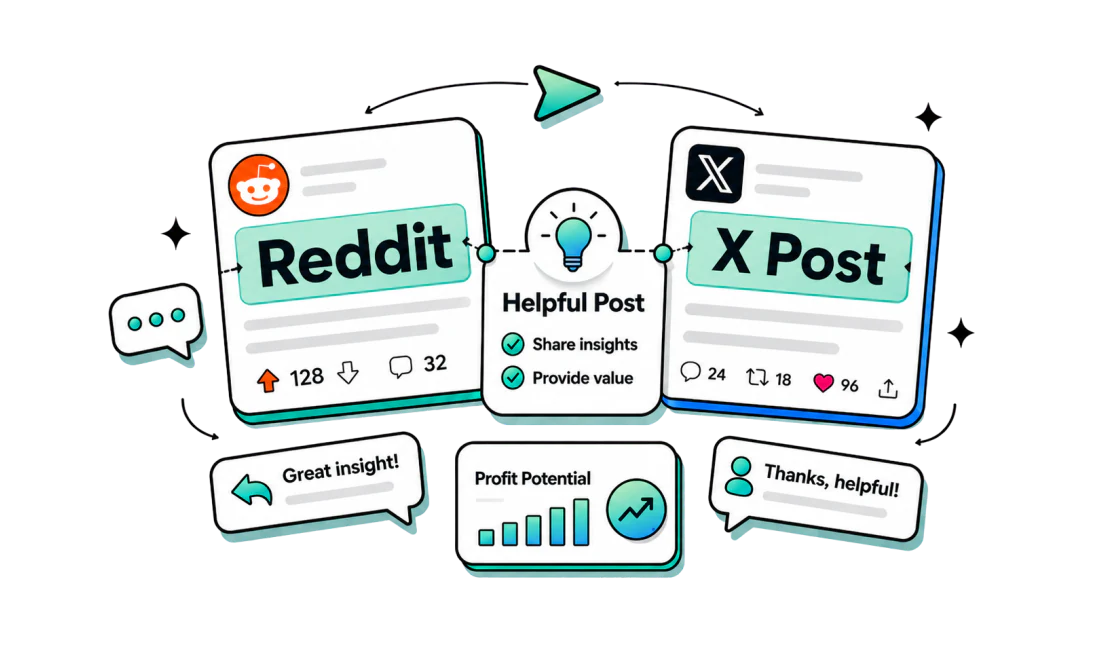
The best part about Reddit and X is that you don’t need a big audience to get reach. If your post feels useful, authentic, and relevant to ecom people, it can still get in front of thousands.
Both Reddit and X users can spot marketing copy fast. If your post feels like a sales pitch, it’ll probably get ignored or treated like spam.
Reddit is mostly about raw experiences, real progress, and asking people who’ve been there for advice.
For your post, you can take one of two angles: an experienced ecom seller sharing what worked, or a beginner asking for help with a real problem.
Keep it specific, natural, and slightly unpolished. Below are sample posts for both angles that you can copy and tweak.
Did you know that 99% of dropshippers can't scale if they have less than 5% net profit margin?
There's no need to explain the difference between a $10M revenue store and a $10K one—scaling matters to any business. But I've worked with many merchants and found that although they can be extremely talented at finding winning products or designing ad strategies, their mindset around scaling is often too simple.
Many merchants I've worked with said that as long as they see a good signal on their ROAS, they'll start investing more to scale up. Others said they'll look for ways to scale once they have steady traffic and orders for 2–3 months or more. Both approaches have fair points, but they're far from enough.
The main issue is that ROAS, orders, or even revenue are never good benchmarks to decide whether it's time to scale up an ecom store. These metrics only tell you how effective your ads are or how much money you're generating (without factoring in costs). They don't reflect your store's financial health. Knowing your store's financial health is the key to scaling tactics, and the only way to know how healthy your store is is to track your net profit and net profit margin.
Net profit tells you exactly how profitable your business is. And profit margin gives you a basic benchmark to know whether it's time to scale up or reevaluate your numbers. Now back to the earlier question—why isn't 5% enough to scale? Because 5% is a very low profit margin compared to the 10–15% market benchmark. When your margin is too low, hidden costs can eat into your profit without you knowing. As a result, you keep scaling and keep losing money. That's why tracking net profit is so important.
You can set up a spreadsheet system to calculate net profit or use apps to auto-track this in real time. If you go with apps, TrueProfit [place your affiliate link here] is my recommendation. It's very easy to get used to (they have a great onboarding flow) and the data is usually more accurate (compared to Google Sheets).
Lost $70 on an order I didn't even ship. Your Google Sheet profit is probably a lie.
I thought I was having a killer month until I checked my actual bank account. Let me tell you about Shopify's BS fees on fraud orders so you don't bleed cash like I did.
I got a $1,500 order. Shopify flagged it as fraud. Cool. I did the right thing, canceled it, and refunded it right away. But Shopify still kept a $55 processing fee. Annoying, but whatever.
Then the scammer hit me with a chargeback. The chargeback canceled out my refund, and Shopify slapped me with ANOTHER $15 fee. And they still kept the original $55. So I'm down $70 for an order I caught as fraud and literally refused to ship.
Look, I get it. If your store is running perfectly and chargebacks are low, these fees might not seem like a big deal. But what happens when you have a rough month and chargeback rates spike? Your profit margin tanks, and because your basic spreadsheet doesn't show these hidden fees, you have no idea why. You start making wild guesses to fix it, maybe you cut ads, maybe you switch products, all based on blind assumptions. That's the fastest way to kill your business.
And remember, chargebacks are just ONE piece of the puzzle. Factor in fluctuating shipping rates, gateway transaction fees, and currency conversions. If you aren't tracking every one of these tightly, the total amount of “hidden costs” will give you a heart attack at the end of the month.
If you're using a basic spreadsheet to track your profits (Revenue - Ads - COGS), you're screwing yourself because spreadsheets can't catch this stuff. You're probably overestimating your take-home profit by 20–30%.
I got sick of guessing and moved to a profit tracker that actually syncs directly with Shopify. It pulls every hidden fee automatically, so you know exactly what you're making down to the penny, with no assumptions.
If you want to stop scaling based on fake numbers, check out TrueProfit here: [place your affiliate link here]. Ditch the spreadsheets before you scale a store that's actually losing money.
X doesn’t reward product posts—it rewards strong takes backed by proof.
Skip product shoutouts, feature lists, and “get it now” copy. Instead, start with a specific pain point or strong observation, back it up with a real number or result, then keep the conversation going in the replies.
Posts that trigger questions, debate, or “same here” reactions usually travel much further than posts that simply promote a product.
A simple formula that works:
Here’s a simple 2-tweet format you can copy, tweak, and plug your affiliate link into:
Shopify said my pet food store was making money.
My bank account said otherwise. Traffic was stable. Orders came in daily. I was still doing this: Shopify revenue minus whatever bills I remembered equals “I think we’re good?”
We were not good.
Built a spreadsheet. Formulas. Tabs. Daily updates. Still 10–15% off the bank. Close enough to lie to myself.
Too far off to scale ads. The worst part wasn’t the math. It was the time. Busy store. Blind operator.
I didn’t have a traffic problem. I had a profit-tracking problem.
Hours reconciling COGS, shipping, and ad spend instead of fixing offers and creatives.
TrueProfit synced Shopify + AutoDS + Facebook, with custom shipping rules by country. Net profit without babysitting Sheets.
If your store is busy but the bank never matches Shopify, that’s the leak. [place your affiliate link here]
| What to Do | What to Avoid |
|---|---|
| Frame your posts around a specific problem, such as hidden transaction fees, manual COGS updates, or unclear profit margins. | Do not use superlatives like “amazing” or “best app ever” in your copy. |
| Switch to a social-native, first-person, lived-experience tone for examples. | Do not add aggressive calls-to-action like “Install now!” or “Buy here!” at the end of templates. |
| Integrate your tracking link naturally as a recommendation or tool mention. | Do not stack hashtags or spam comment threads with raw links. |
Sign up for our affiliate program, grab your link, and start earning today.
